WH-347 example: a filled-out sample, explained
Updated Oct 26, 2026. Not affiliated with the U.S. Department of Labor.
Reading instructions only gets you so far. Below is a complete WH-347 on the current form (Rev. January 2025), filled in for one made-up week, with every number explained. It covers the cases that cause the most mistakes: overtime, a worker in two classifications, fringe paid partly in cash, and a registered apprentice. You can open the sample as a PDF next to this page.
The setup
- Contractor: Example Concrete & Framing LLC, a subcontractor to Hudson Builders Inc.
- Project: Riverside Library Renovation, contract GS-02P-26-XYZ-0042, Troy, NY.
- Wage determination: NY20260012, modification 3 (building). Carpenter $38.42 + $24.10 fringe; Laborer $27.50 + $18.25 fringe.
- Fringe: two funded union plans, Local 9 Health Fund ($14.60 an hour for carpenters, $12.00 for laborers) and Local 9 Pension ($9.50 for carpenters). The laborer's remaining $6.25 of fringe is paid as cash in lieu.
- Week: Sunday to Saturday, ending Saturday 10/17/2026. This is the company's third payroll on the project, so it is certified payroll no. 3.
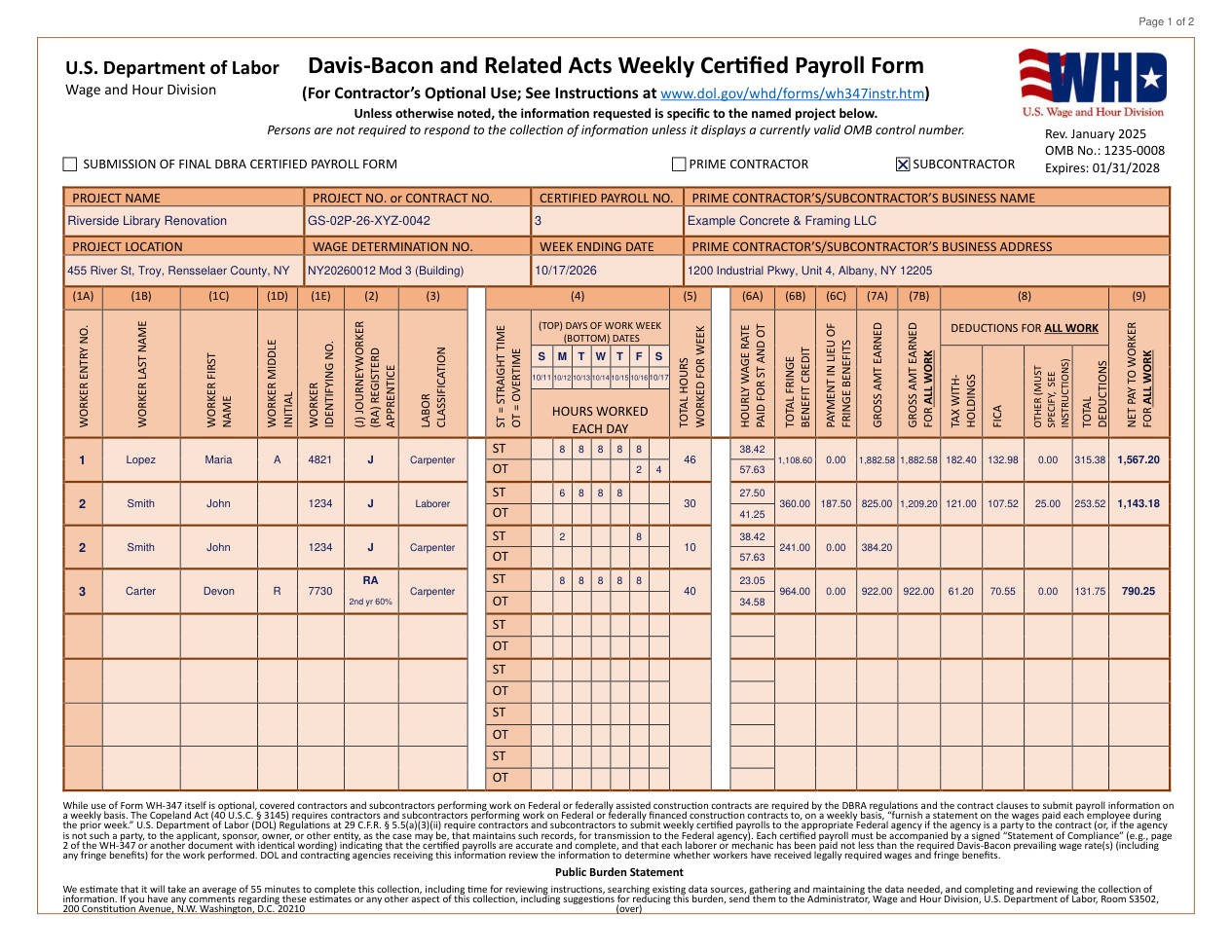
The header
| Field | Sample entry | Why |
|---|---|---|
| Check boxes | Subcontractor | The company is a sub on this project; "final" stays unchecked because work continues. |
| Project no. or contract no. | GS-02P-26-XYZ-0042 | The prime contract number from the agency. |
| Certified payroll no. | 3 | Payrolls are numbered 1, 2, 3… per company and project. |
| Wage determination no. | NY20260012 Mod 3 (Building) | Number and modification, as incorporated in the contract. See finding your wage determination number. |
| Week ending date | 10/17/2026 | The last day of the workweek. |
| Business name and address | Example Concrete & Framing LLC, Albany, NY | Your own company, not the prime's. |
Above the hours columns, the day letters run S M T W T F S with the dates 10/11 to 10/17 under them, matching the Sunday-to-Saturday workweek.
Worker 1: Lopez, a carpenter with overtime
Maria Lopez worked 8 hours Monday to Friday, then 2 more hours on Friday and 4 on Saturday: 46 hours. On a contract with the CWHSSA overtime clause, hours over 40 in the workweek are overtime, so 40 go on the ST line and 6 on the OT line.
| Column | Entry | How |
|---|---|---|
| 1A–1E | 1, Lopez, Maria, A, 4821 | 4821 is a made-up last four of the SSN; never the full number. |
| 2 | J | Journeyworker. |
| 3 | Carpenter | As named in the wage determination. |
| 5 | 46 | 40 ST + 6 OT. |
| 6A | 38.42 / 57.63 | Basic rate; overtime is 1.5 × 38.42, with fringe left out. |
| 6B | 1,108.60 | 46 hours × $24.10 plan credit. Fringe is owed on overtime hours too, but never multiplied by 1.5. |
| 6C | 0.00 | All her fringe goes to the plans. |
| 7A | 1,882.58 | 40 × 38.42 + 6 × 57.63. |
| 7B | 1,882.58 | She had no other work that week. |
| 8 | 182.40 + 132.98 + 0.00 = 315.38 | Tax withholdings, FICA, other, total. |
| 9 | 1,567.20 | 1,882.58 + 0.00 − 315.38. |
More on the rules in overtime on certified payroll.
Worker 2: Smith, two classifications and cash in lieu
John Smith worked 30 hours as a laborer (Monday 6, Tuesday to Thursday 8 each) and 10 as a carpenter (2 on Monday, 8 on Friday). That is 40 hours, so there is no overtime. He gets two rows with the same entry number, 2, one per classification, as DOL's instructions require.
| Column | Laborer row | Carpenter row |
|---|---|---|
| 4 hours | 6, 8, 8, 8 | 2, 8 |
| 5 total | 30 | 10 |
| 6A | 27.50 / 41.25 | 38.42 / 57.63 |
| 6B | 360.00 (30 × 12.00 health) | 241.00 (10 × 24.10) |
| 6C | 187.50 (30 × 6.25 cash) | 0.00 |
| 7A | 825.00 | 384.20 |
Columns 7B, 8 and 9 are "for all work," so they appear once, on his first row:
- 7B: 825.00 + 384.20 = 1,209.20.
- 8: tax 121.00, FICA 107.52, other 25.00 (union dues), total 253.52.
- 9: 1,209.20 + 187.50 cash in lieu − 253.52 = 1,143.18.
The $25.00 "Other" deduction must be described. Here it goes in Additional Remarks on page 2. Union dues are a permitted deduction under 29 CFR 3.5(h) when provided for in a collective bargaining agreement; see certified payroll deductions. The cash in lieu is reported in 6C and kept out of 6A, as explained in WH-347 fringe benefits.
Worker 3: Carter, a registered apprentice
Devon Carter is a second-year carpentry apprentice in a program registered with DOL's Office of Apprenticeship, paid 60% of the journeyworker rate.
| Column | Entry | How |
|---|---|---|
| 2 | RA, 2nd yr 60% | "RA" plus the apprentice's level in the program. |
| 3 | Carpenter | The work performed, not "apprentice." |
| 6A | 23.05 / 34.58 | 60% of 38.42, rounded to the cent; overtime would be 1.5 × 23.05 = 34.575, shown rounded up so it never falls below time and a half. |
| 6B | 964.00 | 40 × 24.10. This sample assumes the program pays apprentices the full fringe, which is also the rule when a program says nothing about fringe. |
| 7A / 7B | 922.00 | 40 × 23.05. |
| 8 | 61.20 + 70.55 = 131.75 | |
| 9 | 790.25 | 922.00 − 131.75. |
Paying an apprentice rate is only allowed for workers individually registered in a registered program; see apprentices on WH-347.
Page 2: the Statement of Compliance
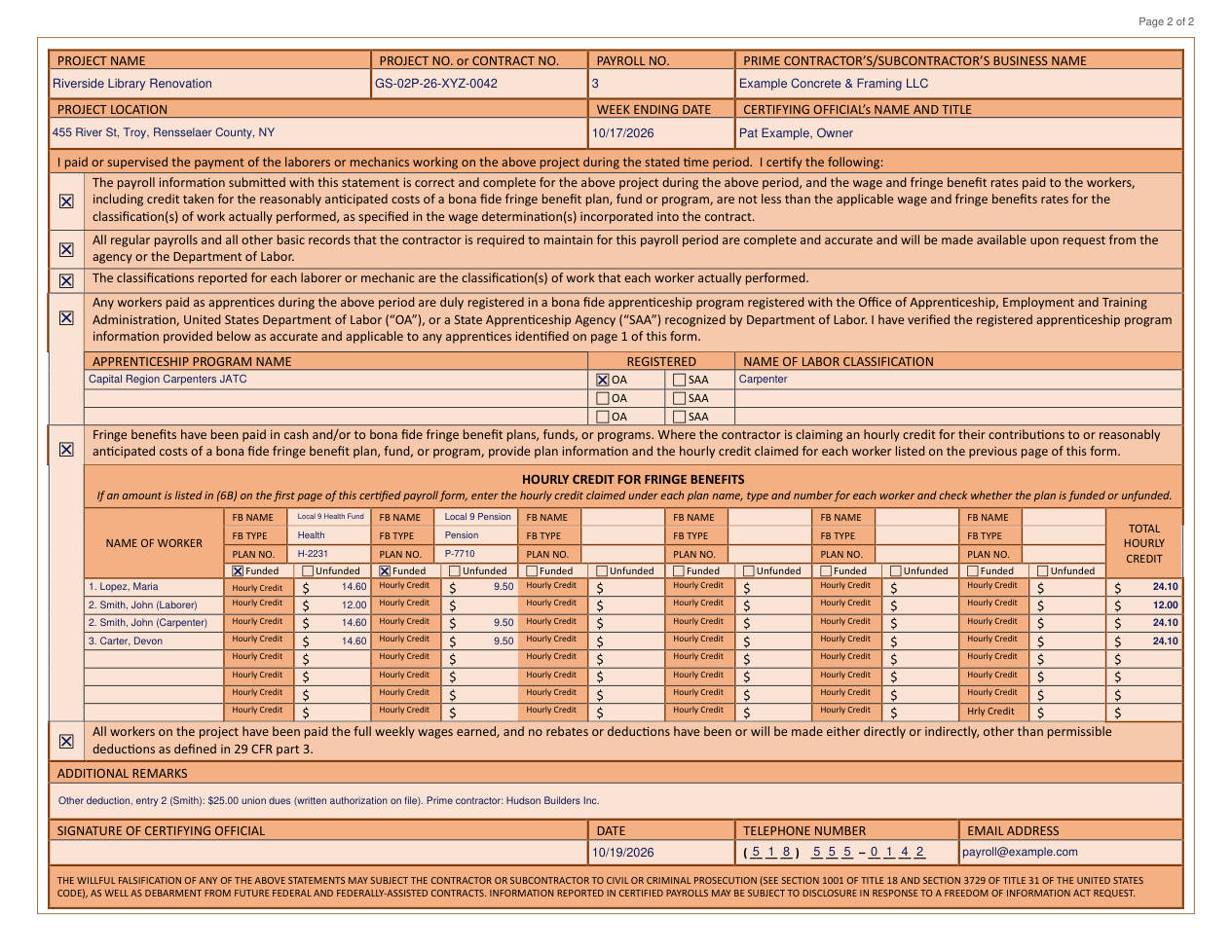
- Boxes 1, 2, 3 and 6 are checked, as on every payroll.
- Box 4 is checked because Carter is paid as an apprentice. The table lists Capital Region Carpenters JATC, registered with the OA, classification Carpenter.
- Box 5 is checked because fringe is owed and paid. The hourly credit table lists both plans (name, type Health / Pension, plan numbers H-2231 and P-7710, both funded) and each worker's credit per plan: Lopez 14.60 + 9.50 = 24.10, Smith as a laborer 12.00, Smith as a carpenter 24.10, Carter 24.10. Each worker's 6B equals hours × that total.
- Additional remarks: "Other deduction, entry 2 (Smith): $25.00 union dues (written authorization on file). Prime contractor: Hudson Builders Inc." Naming the prime is optional but saves the reviewer a question.
- Certifying official: Pat Example, Owner, dated 10/19/2026, with phone and email. The signature line is left blank in the sample; you sign by hand or with a legally valid electronic signature.
Each box is explained in the Statement of Compliance, explained.
Checks to run on your own payroll
These are the reconciliations a reviewer runs, and every row of the sample passes them:
- ST + OT hours = column 5, and OT only after 40 hours in the workweek.
- 6A bottom line = 1.5 × the basic rate, never including fringe or cash in lieu.
- 6B = total hours × the page 2 hourly credit for that worker.
- 6C = total hours × the cash paid in lieu of fringe.
- 7A = ST hours × ST rate + OT hours × OT rate, row by row.
- 9 = 7B + 6C − 8, and it matches the check or deposit you actually paid.
- Rates in 6A + hourly fringe are at least the wage determination for the classification in column 3 (for a registered apprentice, the rate the program sets).
Make your own
The sample was produced by WH-347 Kit from the setup above: the crew, rates and fringe plans are entered once, each week's hours go in by day, and the app fills both pages of the official form. Your first report is free. For a field-by-field walkthrough of a blank form, see how to fill out WH-347.
Common questions
Is this a real certified payroll?
No. The company, project, wage determination and workers are made up. The numbers are worked out with the same rules a real payroll follows, so you can check every figure.
Can I copy this sample for my own payroll?
Use it to see what goes where, not as your data. Your classifications, rates and fringe must come from the wage determination in your contract, and your deductions from your own payroll.
Why does Smith appear on two rows with the same number?
He worked as a laborer and as a carpenter in the same week. DOL's instructions say to use a separate row for each classification with the same worker entry number, and to show gross for all work, deductions and net pay once.
Sources
- DOL WHD — Form WH-347 instructions — retrieved 2026-10-26
- DOL WHD — Form WH-347, Rev. January 2025 (PDF) — retrieved 2026-10-26
- eCFR — 29 CFR 5.5, contract clauses (apprentices, payrolls) — retrieved 2026-10-26
- eCFR — 29 CFR 5.32, overtime and fringe benefits — retrieved 2026-10-26